.jpg)


 1. Branding or Performance? A Dilemma Faced by Many Business Owners
During a strategy consultation, a young founder once asked us a very straightforward question:
"Should a business invest in branding first, or focus on performance marketing to generate revenue? Can branding actually drive sales?"
This is not a new question. Yet every time we hear it, we do not rush to answer.
Because this is not a theoretical exercise. It is a very practical concern shared by business leaders who face growth pressure every day. Budgets are limited. Revenue targets cannot wait. Cash flow must be maintained. Meanwhile, advertising performance is becoming increasingly difficult to predict.
The short answer is: both matter.
The more complete answer is: businesses need to understand where they are today, what they need most right now, and when branding and performance should work together to create meaningful growth.
If performance helps a business survive in the short term, branding is what helps it endure in the long term.
2. What Is the Difference Between Branding and Performance Marketing?
In many organizations, branding and performance marketing are often viewed as competing priorities.
Either invest in building a brand.
Or focus on running ads that generate sales.
In reality, they are not competitors. They solve two completely different business challenges.
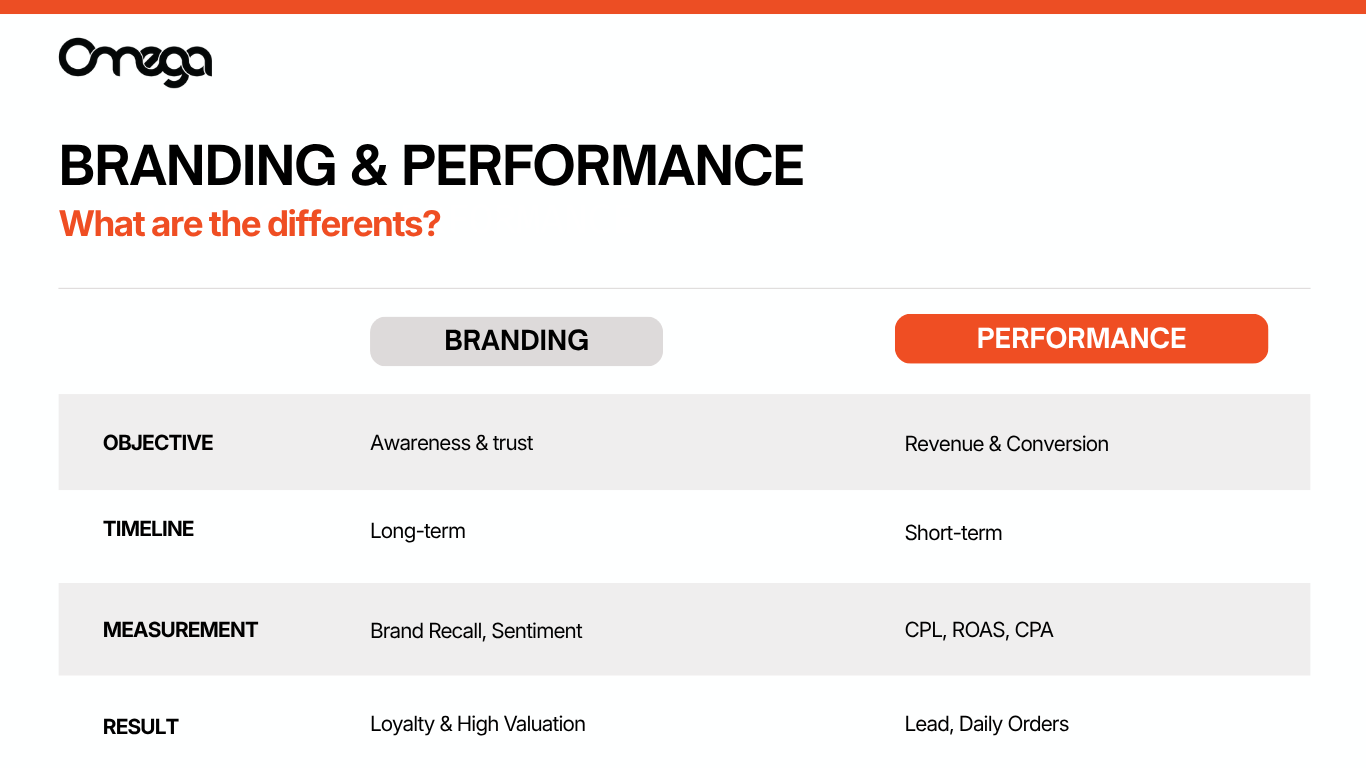
Performance marketing focuses on measurable outcomes that can be tracked immediately. These outcomes may include leads, purchases, conversion rates, or revenue generated from a specific campaign.
Branding, on the other hand, focuses on building awareness, trust, and emotional connections with customers over time.
If performance marketing answers the question, "How do we generate sales today?", branding answers the question, "How do we ensure customers remember us tomorrow?"
Performance can improve short-term business metrics. Branding makes those results more sustainable over time.
In other words, branding may not generate sales instantly, but it makes every sales and marketing effort more effective.
Strong brands typically enjoy:
Lower advertising costs
Higher conversion rates
Greater ability to expand into new markets
Stronger customer loyalty
Better pricing power compared to competitors
 3. Branding Is Not About Making a Brand Look Better
One of the most common misconceptions about branding is that it is simply a design exercise.
Many businesses assume branding means creating a better logo, a more polished visual identity, or a more emotional advertising campaign.
In reality, branding is much broader than that.
A brand is not what a company says about itself.
A brand is what customers feel after interacting with the company.
It is the story the business tells.
It is how employees communicate.
It is the website experience.
It is how customer issues are handled.
It is the lasting impression left behind after every interaction.
A strong brand does more than improve recognition.
It builds trust.
And trust is one of the most valuable long-term competitive advantages any business can have.
Airbnb offers a compelling example.
Between 2014 and 2015, Airbnb invested heavily in digital advertising to accelerate global growth. The strategy worked. User acquisition increased rapidly.
However, advertising costs continued to rise while customer loyalty did not grow at the same pace.
Beginning in 2019, Airbnb shifted its focus toward brand building.
Instead of promoting booking functionality alone, the company centered its communication around the idea of human connection through its famous message: "Belong Anywhere."
At the same time, Airbnb improved its user experience and built a more consistent global brand identity.
The results were significant. Branded search volume increased, dependence on paid advertising declined, and Airbnb evolved from being perceived as a booking platform into a lifestyle brand associated with travel experiences and belonging.
That is the power of branding.
4. Businesses Cannot Survive Without Performance Marketing
While branding is essential, that does not mean businesses can ignore performance marketing.
This is especially true during the early stages of growth.
A strong brand takes time to build.
Revenue cannot wait.
Performance marketing allows businesses to:
Validate market demand
Confirm product-market fit
Generate revenue quickly
Collect customer data
Optimize sales messaging
More importantly, performance marketing enables businesses to learn quickly.
Rather than guessing what customers want, companies can use real-world data to find answers.
A practical example from Vietnam is Coolmate.
In its early years, Coolmate did not invest heavily in large-scale brand campaigns.
Instead, the company focused on performance marketing.
The team continuously tested:
Landing pages
Advertising messages
Pricing strategies
Promotional offers
Customer behavior patterns
This approach helped them quickly identify a model that resonated with modern male consumers: convenience, quality products, and a seamless shopping experience.
Only after finding a successful formula did Coolmate begin investing more heavily in branding.
The company started telling a broader story around local manufacturing, sustainability initiatives, and operational transparency.
As the brand became clearer, advertising performance improved. Customers returned more frequently. The business became remembered not only for its products but also for what it stood for.
5. Brandformance: When Branding and Performance Become One Growth System
Today, more businesses are realizing that the question is no longer:
"Should we choose branding or performance?"
The better question is:
"How can we make both work together within the same growth system?"
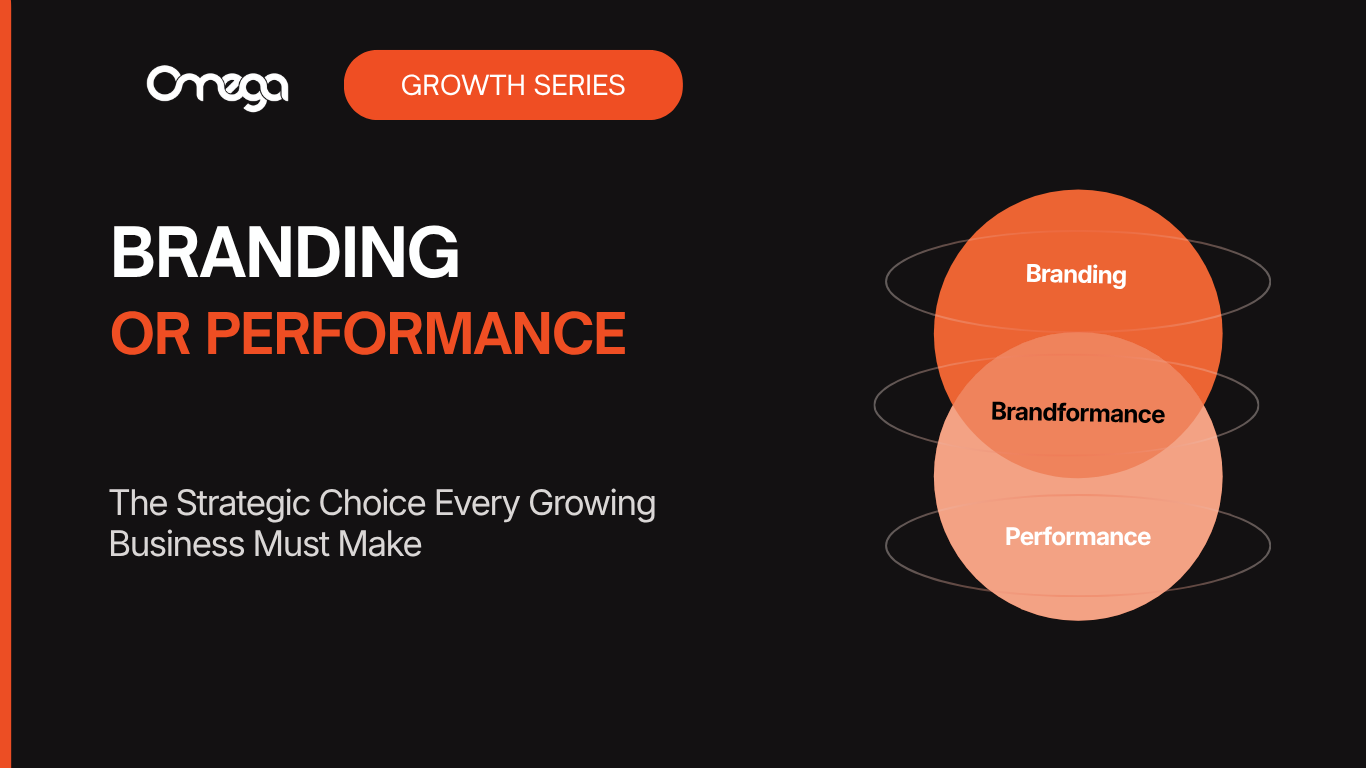
This is the idea behind Brandformance.
Brandformance does not mean splitting the marketing budget evenly between branding and performance.
It means combining emotional connection with data-driven execution.
It means connecting brand building with revenue generation.
In an effective Brandformance system:
Branding creates demand, while performance converts that demand into revenue.
Branding builds trust, while performance generates data.
Branding helps customers remember, while performance motivates them to act.
These two disciplines are not opposing forces.
They strengthen one another.
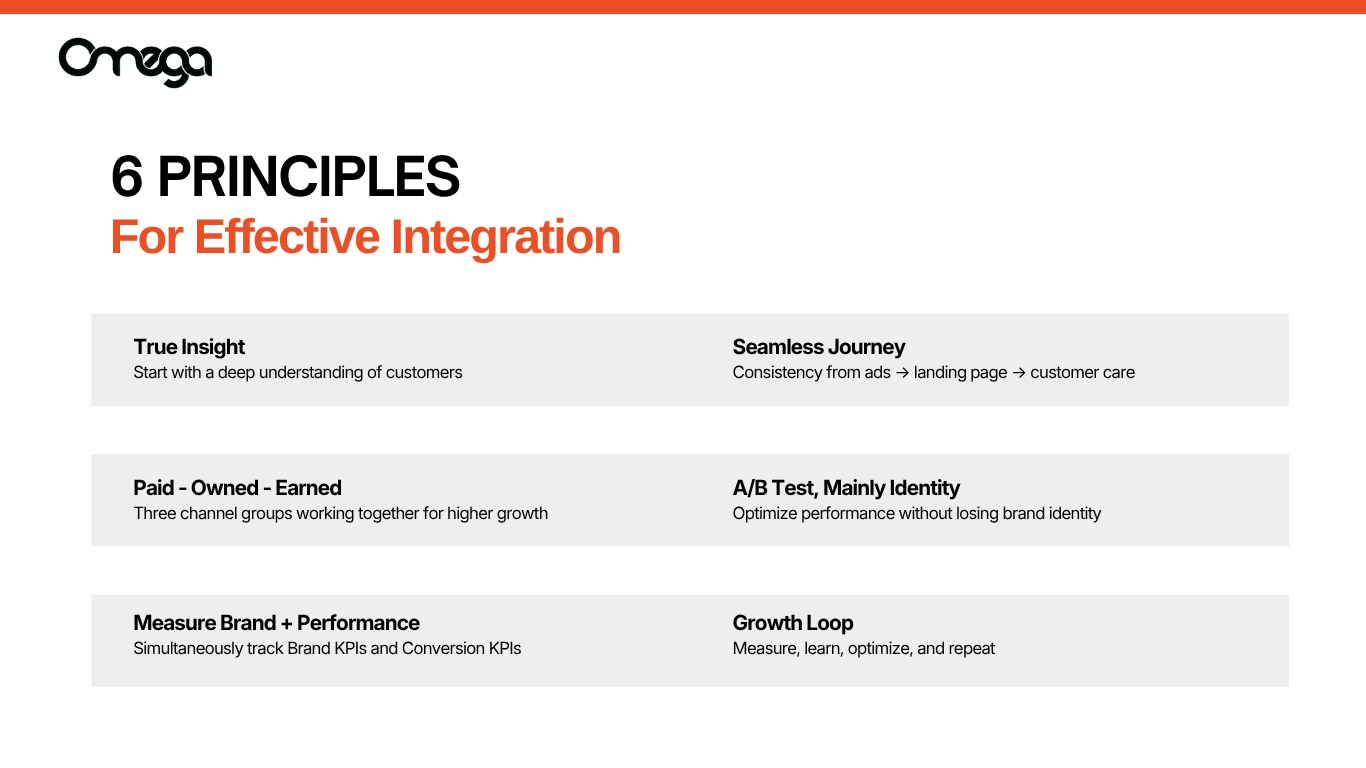
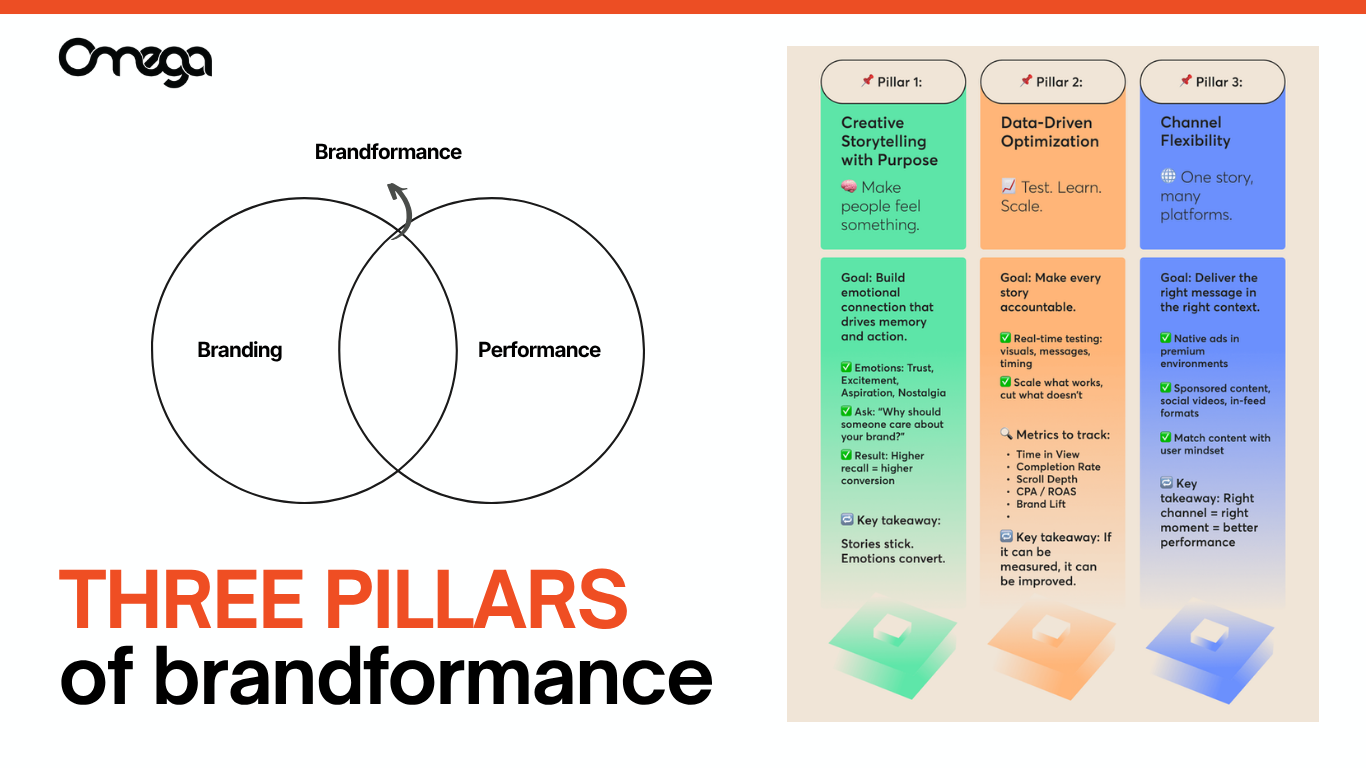 6. Six Principles for Combining Branding and Performance Effectively
6.1. Start with Real Customer Insights
Great brand campaigns do not begin with creative ideas.
They begin with customer understanding.
The level of research required should be just as rigorous as the research used to build a high-converting landing page.
For example, Samsung's Z Flip campaign did not simply highlight the phone's folding capability. It tapped into young consumers' desire for self-expression and individuality.
6.2. Design a Seamless Customer Journey
Messages across advertising, social media, landing pages, emails, and customer service interactions should feel connected.
Strong brands are built through consistency.
6.3. Combine Paid, Owned, and Earned Media
Paid media expands reach.
Owned media nurtures relationships.
Earned media builds credibility and trust.
When all three channels work together, growth becomes significantly more effective.
6.4. Run A/B Tests Without Losing Brand Identity
Performance optimization is important.
However, optimization should never come at the expense of brand positioning.
Customers should recognize who you are regardless of where they encounter your content.
6.5. Measure Both Brand and Performance KPIs
An effective campaign should track both brand and business metrics.
Brand KPIs
Brand Awareness
Brand Recall
Search Volume
Brand Sentiment
Performance KPIs
Click-Through Rate (CTR)
Conversion Rate
Return on Ad Spend (ROAS)
Customer Acquisition Cost (CAC)
Retention Rate
6.6. Think in Growth Loops, Not Just Funnels
Branding often plays a critical role in awareness and consideration.
Performance accelerates conversion and retention.
Long-term growth comes from continuously measuring, learning, optimizing, and repeating the process.
 Conclusion
Sustainable growth does not come from doing branding better or performance marketing better in isolation. It comes from connecting the two into a unified system. When branding and performance work together effectively, businesses achieve more than revenue growth. They build long-term brand value that compounds over time.
At Omega Media, we help businesses develop comprehensive Brandformance strategies that connect brand building with measurable business outcomes.
Contact us today to discover how your business can create a growth system that delivers both immediate results and long-term value.