.jpg)


 Google Ads is Google’s online advertising platform. It allows businesses to reach potential customers across Google Search, YouTube, websites, apps, and other touchpoints within Google’s advertising ecosystem.
Advertisers can use Google Ads to generate sales, acquire leads, increase website traffic, promote mobile apps, or build brand awareness. They can also control campaign budgets, targeting signals, ad content, bidding strategies, and conversion measurement.
The platform provides extensive performance data. However, more data does not always lead to better decisions. Advertisers need to understand how different metrics connect before deciding whether a campaign is truly effective.
1. How does Google Ads work?
Google Ads connects an advertiser’s objective with a user’s context and intent.
An advertiser selects a campaign goal, provides ad assets, defines targeting signals, sets a budget, and chooses a bidding strategy. Google then distributes and optimizes the campaign according to those settings and the available conversion data.
For Search campaigns, an auction may occur whenever a user enters a relevant query. Winning the auction does not depend solely on submitting the highest bid.
According to Google, Ad Rank considers several factors, including:
- The advertiser’s bid
- Ad and landing page quality
- Ad Rank thresholds
- Auction competitiveness
- The context of the search
- The expected impact of ad assets and formats
This means Google Ads is not simply a system for buying ad positions. Advertisers compete through a combination of bids, relevance, creative quality, and the experience users receive after clicking an ad.
2. What types of Google Ads campaigns are available?
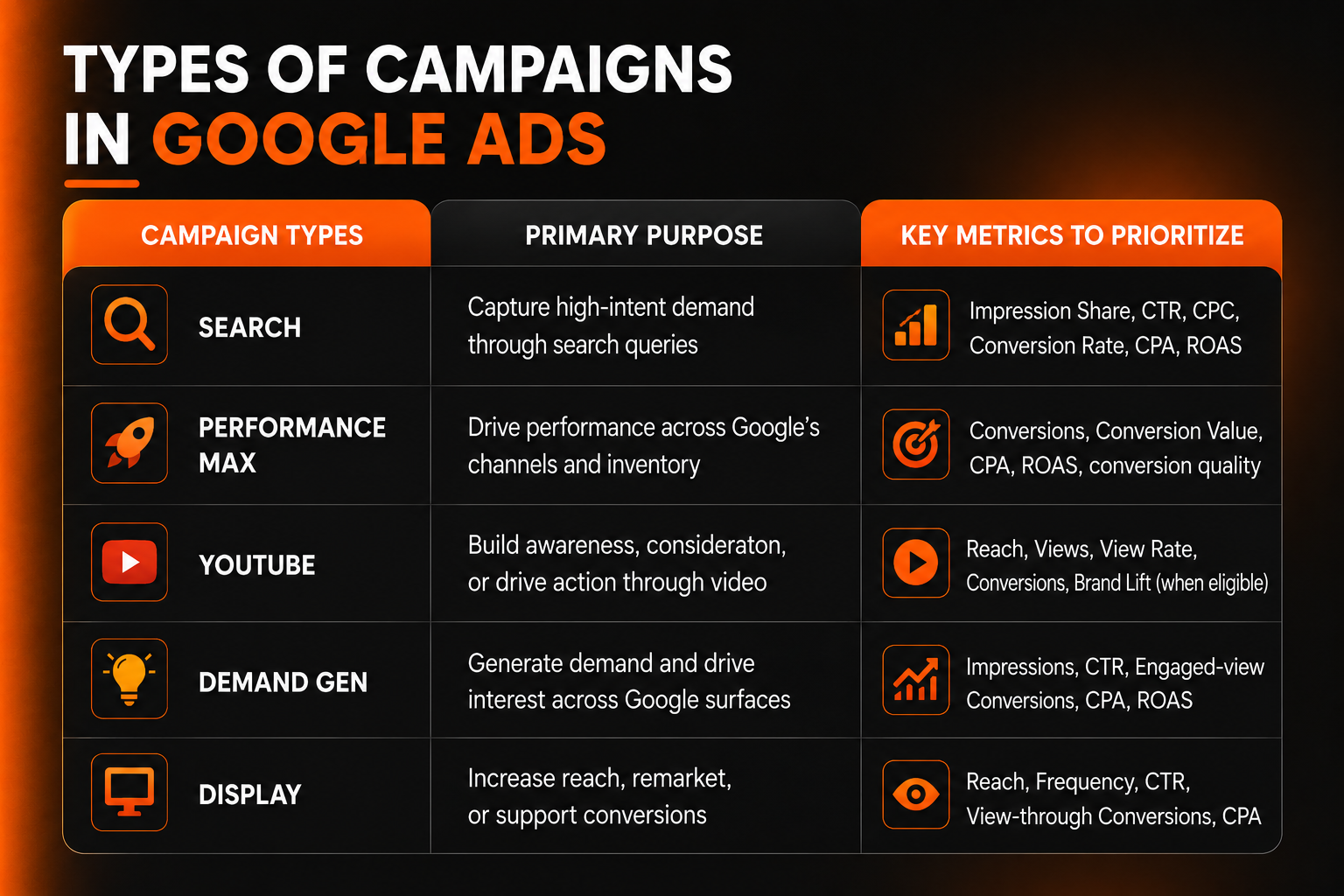
Google Ads offers several campaign types for different stages of the customer journey. Common options include:
- Search campaigns: Capture existing demand from users actively searching for a product, service, or solution.
- Performance Max campaigns: Use Google AI to distribute ads across multiple Google channels.
- YouTube campaigns: Build awareness, consideration, and demand through video.
- Demand Gen campaigns: Generate interest across Google’s visual and discovery-oriented surfaces.
- Display campaigns: Reach users across websites, apps, and Google properties.
The right campaign type depends on the business objective, creative assets, conversion data, audience, and level of existing demand.
Advertisers should avoid comparing the CTR of Search, Display, and YouTube campaigns without considering their roles. Each format appears in a different context and addresses a different stage of the customer journey.
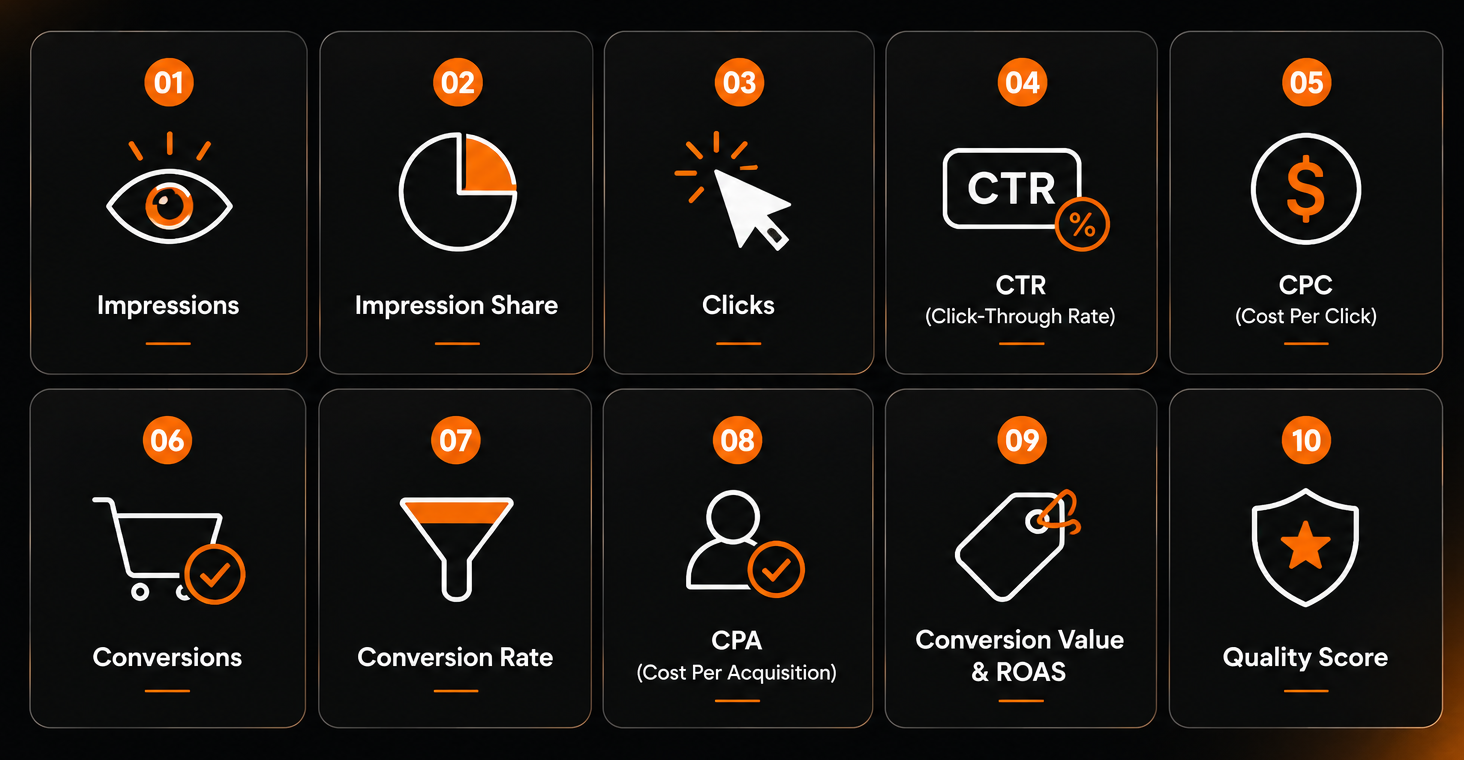
 3. Ten essential Google Ads metrics
 3.1. Impressions: Are your ads being shown?
Impressions represent the number of times an ad is displayed.
This metric shows the campaign’s actual delivery scale. However, impressions do not prove that users noticed, clicked, or converted after seeing the ad.
Low impressions may result from:
- Limited search demand
- Narrow targeting
- Insufficient budget
- Low bids
- Weak Ad Rank
- Ad approval issues
- Restrictive campaign settings
Impressions should be treated as the beginning of a diagnosis, not as evidence of campaign success.
3.2. Impression Share: How much eligible visibility are you capturing?
Impression Share is the percentage of impressions an ad received compared with the estimated number it was eligible to receive.
Two related metrics help diagnose lost opportunities:
- Search Lost Impression Share (budget): Visibility lost because of insufficient budget.
- Search Lost Impression Share (rank): Visibility lost because of insufficient Ad Rank.
Impression Share is particularly useful when a profitable campaign struggles to scale.
If a campaign loses substantial Impression Share because of budget, increasing the budget may unlock additional volume. If the loss comes from rank, spending more may not solve problems involving ad relevance, landing page experience, or auction competitiveness.
3.3. Clicks: How much traffic are your ads generating?
Clicks measure how many times users select an ad.
This indicates the amount of traffic generated, but it does not show whether that traffic is relevant or valuable.
A campaign can receive many clicks and still underperform if:
- Search queries have the wrong intent.
- The landing page does not match the ad.
- The offer is not competitive.
- Conversion tracking counts low-value actions.
- Visitors do not qualify as potential customers.
Clicks should therefore be evaluated alongside CTR, CPC, conversion rate, CPA, and conversion quality.
3.4. CTR: Are your ads relevant enough to earn clicks?
Click-through rate, or CTR, measures the percentage of impressions that result in clicks.
A low CTR may indicate that the keywords are poorly aligned with user intent, the message is not compelling, or the ad is reaching an unsuitable audience.
However, a high CTR does not automatically indicate business success. A curiosity-driven headline may attract many clicks from users who are unlikely to convert.
CTR should be used to evaluate ad relevance and engagement, not as a substitute for conversion or revenue metrics.
3.5. CPC: How much does each click cost?
Average cost per click measures the average amount paid for each ad click.
A lower CPC allows a business to acquire more traffic with the same budget. Yet the cheapest traffic is not always the most valuable.
High-CPC keywords may generate customers with greater purchase intent or lifetime value. Pausing them merely to reduce average CPC could lower total revenue.
CPC is an input cost. It is not proof of profitability. The amount charged for an individual click is also influenced by auction conditions and Ad Rank factors.
3.6. Conversions: What valuable actions are users taking?
A conversion is an action that a business defines as valuable. Examples include:
- Completing a purchase
- Submitting a lead form
- Making a phone call
- Registering an account
- Booking an appointment
- Downloading an app
Conversion tracking connects advertising interactions with these actions.
Measurement quality becomes critical at this stage. If a thank-you page is counted twice, a brief phone call is treated as a qualified lead, or an add-to-cart event has the same value as a completed purchase, the algorithm may optimize effectively toward the wrong outcome.
Before scaling a campaign, businesses should verify which actions are included as primary conversions and whether those actions reflect genuine business value.
3.7. Conversion rate: Does traffic turn into action?
Conversion rate measures the percentage of eligible ad interactions that result in conversions.
If CTR is healthy but conversion rate is low, the problem may occur after the click. Common causes include:
- A mismatch between the search query and the offer
- Slow page loading
- Poor mobile usability
- An overly complicated form
- Uncompetitive pricing
- Weak trust signals
- Ad messaging that overpromises
A low conversion rate should not automatically lead to changes in bidding or targeting. The landing page, offer, user journey, and tracking setup should also be reviewed.
3.8. CPA: How much does each acquisition cost?
Cost per acquisition or action measures how much advertising spend is required to generate one recorded conversion. In Google Ads, it is commonly reported as cost per conversion.
CPA is useful only when the conversion represents meaningful business value.
For lead-generation campaigns, a cheap lead that never qualifies may be more expensive than a higher-CPA lead with a strong closing rate. B2B companies should connect Google Ads with their CRM to measure additional metrics such as:
- Cost per qualified lead
- Cost per opportunity
- Cost per customer
- Lead-to-opportunity rate
- Customer acquisition cost
This creates a clearer picture of performance than platform CPA alone.
3.9. Conversion value and ROAS: How much value does advertising generate?
Conversion value is the total value assigned to recorded conversions.
In Google Ads, the conversion value divided by cost metric is commonly used to represent return on ad spend.
For example, if a business spends $10,000 and attributes $40,000 in revenue to advertising, its ROAS is 4.0 or 400%.
ROAS is not the same as profit. It does not automatically account for:
- Cost of goods sold
- Operating expenses
- Promotional discounts
- Product returns
- Payment fees
- Agency fees
- Fullfilment costs
A campaign can report an attractive ROAS while remaining below the company’s break-even point. Businesses should define their required ROAS based on margins and operating economics rather than relying on a universal benchmark.
3.10. Quality Score: What should advertisers use it to diagnose?
Quality Score is a keyword-level diagnostic score ranging from 1 to 10. It is based on three components:
- Expected CTR
- Ad relevance
- Landing page experience
Google explicitly states that Quality Score is not a KPI and is not a direct input in the ad auction. It should be used to identify areas where the user experience may need improvement.
The goal should not be to make every keyword score 10 out of 10.
A low-scoring keyword may still be worth keeping if it generates profitable customers. Conversely, a high Quality Score cannot rescue a campaign that fails to produce revenue.
4. Which Google Ads metrics should you track for each objective?
There is no single “most important” KPI for every Google Ads campaign. The right metrics depend on the job assigned to the campaign.
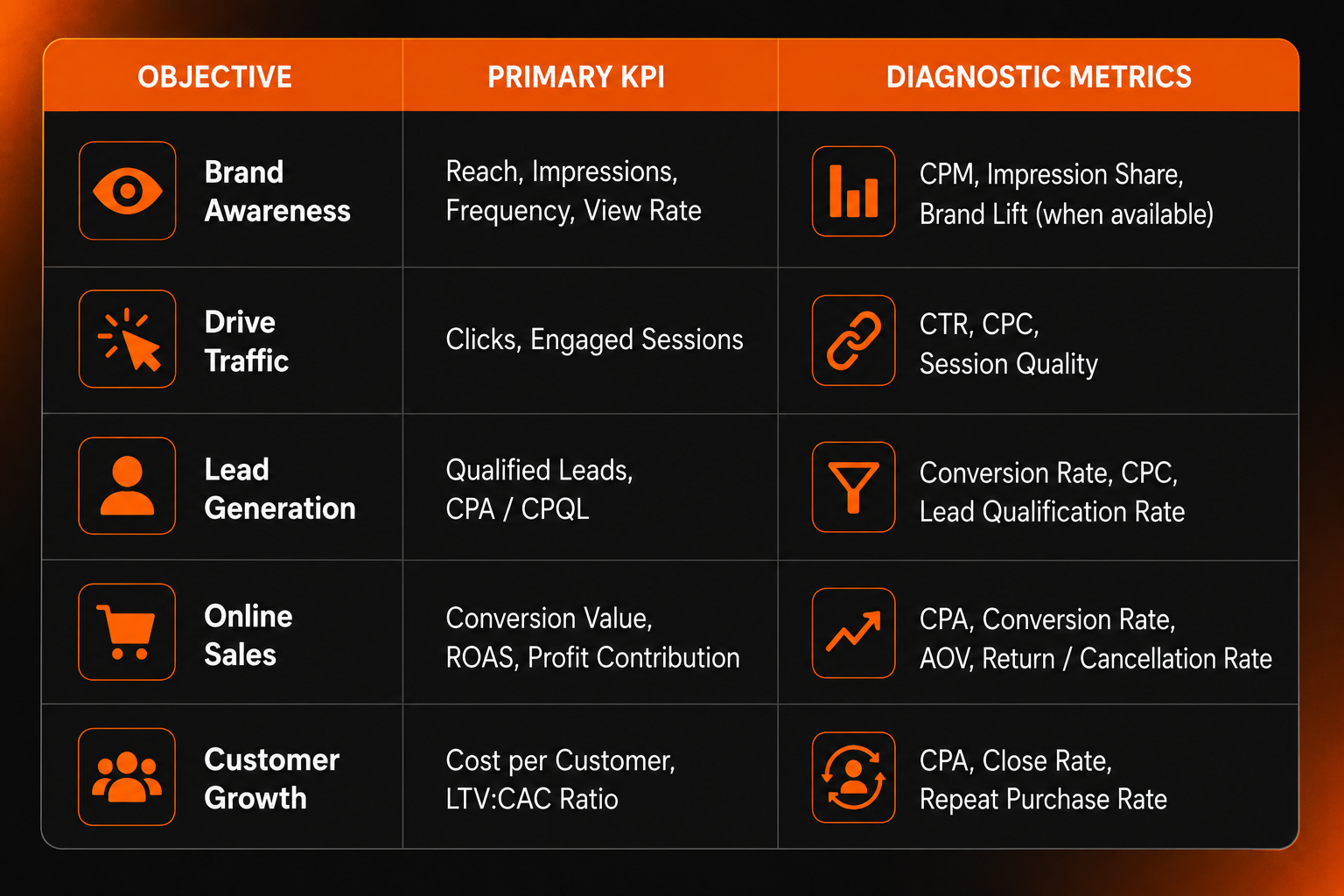 Platform data should also be connected with information outside Google Ads.
Google Ads can confirm that a form was submitted. A CRM can reveal whether the lead was qualified, contacted, converted into an opportunity, signed a contract, and generated revenue.
For this reason, mature measurement should connect: Impressions -> Clicks -> Conversions -> Qualified leads -> Customers -> Revenue -> Profit
Conclusion
Google Ads is powerful because it turns user behavior into measurable data. That strength can also become a trap: businesses may optimize the most visible metric instead of the outcome that matters most.
A healthy Google Ads account does not necessarily have perfect numbers across every campaign. It has clear objectives, reliable tracking, logically connected metrics, and the ability to explain how advertising spend moves through the funnel to create customers, revenue, and profit.
Rather than asking whether CTR, CPC, or ROAS is “good,” businesses should ask whether the measurement system reflects their actual economics.