.jpg)


 1. When Marketing can no longer carry growth alone
For many years, whenever businesses talked about growth, the default response was simple: assign more KPIs to the Marketing team.
Need more customers? Marketing will handle it.
Need more traffic? Marketing will take care of it.
Need more leads? That's Marketing's responsibility.
Even when conversion rates decline, customer retention drops, or revenue falls short of expectations, the first question is often directed toward the marketing department.
This approach is not entirely wrong. Marketing plays a critical role in generating demand, attracting customers, and driving awareness. However, treating Marketing as the sole owner of growth overlooks the true nature of sustainable business growth.
Growth has never been the responsibility of a single department.
It is the outcome of multiple functions working together across the entire organization.
A company can spend millions on advertising and attract millions of website visitors. Yet if the product fails to deliver value, the user experience is poor, pricing is misaligned with customer expectations, or customer service cannot retain users, much of that marketing investment will be wasted.
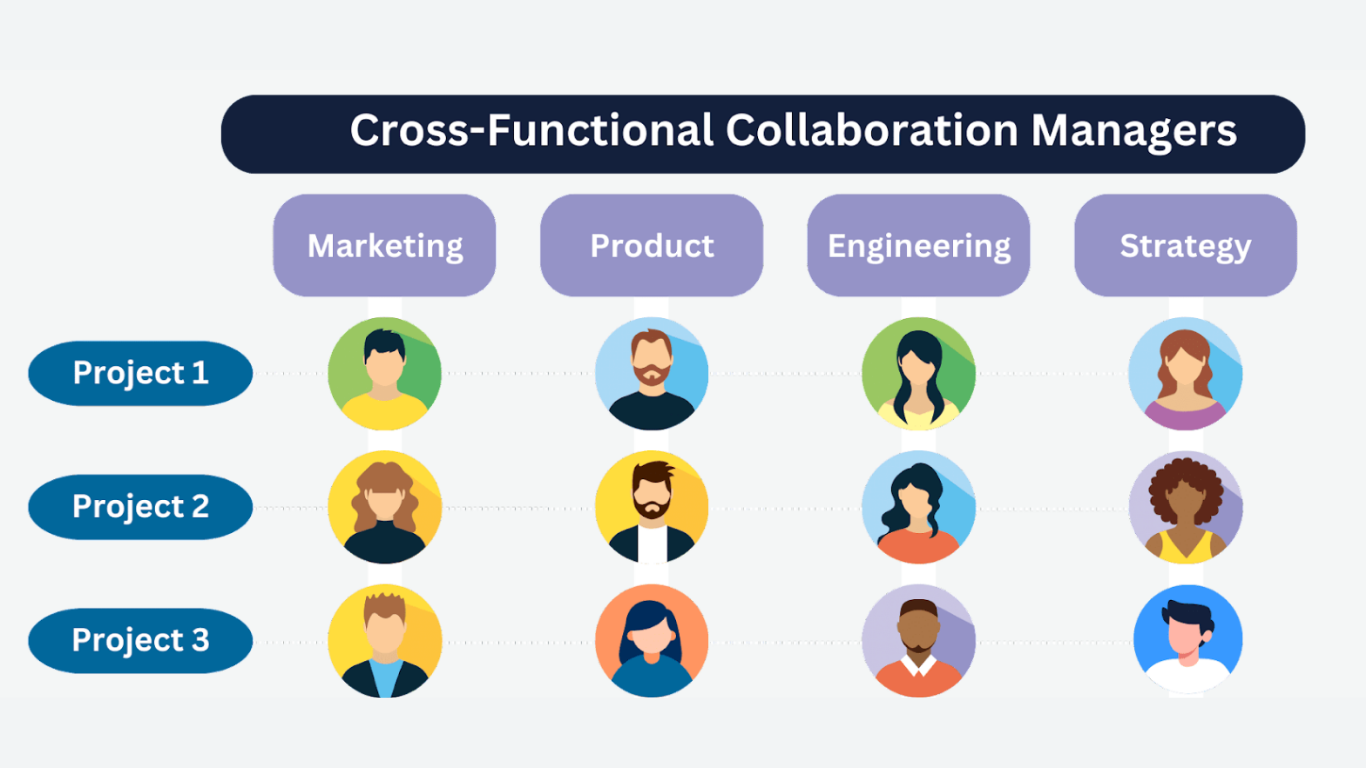
This is why the fastest-growing companies today no longer operate with siloed departments. Instead, they build cross-functional Growth Teams where different functions collaborate around one shared objective: sustainable growth.
Growth is no longer a marketing initiative. It is an organizational capability.
2. What is a Growth Team?
A Growth Team is a cross-functional group created to identify, test, and implement opportunities that accelerate business growth.
Unlike traditional organizational structures, a Growth Team is not necessarily a standalone department. Instead, it brings together people from different disciplines who collaborate around a shared growth objective.
Rather than focusing on individual departmental KPIs, Growth Teams focus on the entire customer journey.
How do customers discover the brand?
What is their first experience with the product?
What motivates them to make a purchase?
Why do they stay, upgrade, refer others, or leave?
Every decision is driven by data, experimentation, and business outcomes rather than departmental priorities.
Growth requires Cross-Functional thinking
A highly effective Growth Team does not need to be large.
What matters is having diverse perspectives represented within the team.
A typical Growth Team may include:
Marketing – Drives awareness, acquisition, and demand generation.
Product – Improves onboarding, user experience, and product adoption.
Data & Business Intelligence – Transforms data into actionable insights and growth opportunities.
CRM & Customer Success – Focuses on retention, engagement, and customer lifetime value.
Sales – Converts prospects into paying customers and provides valuable market feedback.
The power of a Growth Team comes from its ability to connect these functions around a common objective instead of allowing them to operate independently.
3. How to structure a Growth Team at different business stages
There is no universal Growth Team structure.
The right model depends on the company's stage of development, available resources, and growth objectives.
3.1 Early-stage companies (Startups and SMEs)
At the startup stage, resources are limited and speed matters more than specialization.
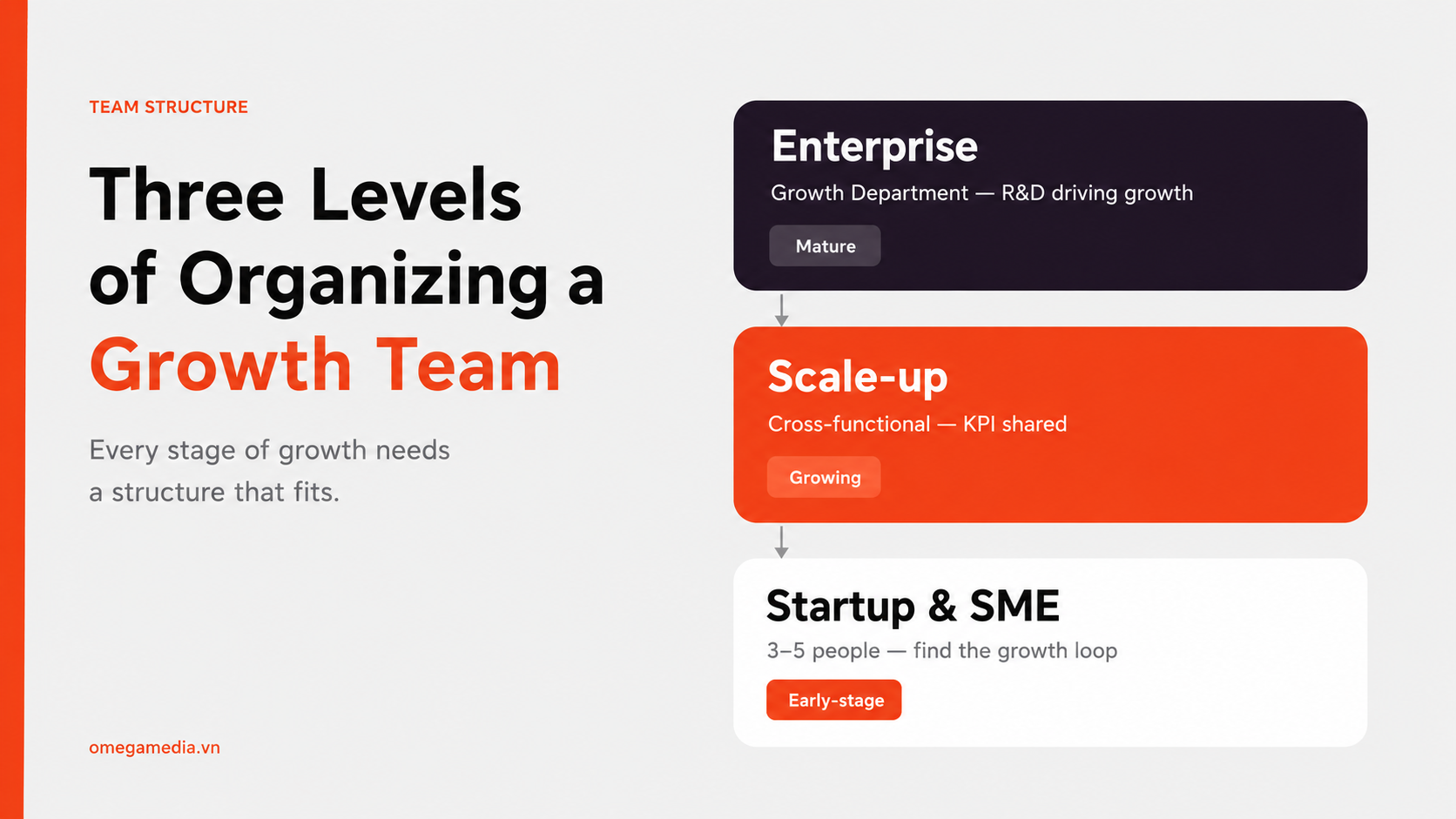
Growth Teams are typically small, consisting of three to five people.
Roles often overlap.
A marketer may design landing pages.
A product manager may analyze user data.
The founder may directly participate in growth experiments.
At this stage, the priority is not building perfect processes. The priority is learning as quickly as possible.
Every assumption should be tested.
Every campaign should generate insights.
Every experiment should answer a business question.
The goal is not immediate scale.
The goal is discovering the company's first growth loop and understanding what truly drives growth.
Companies that learn faster than competitors usually grow faster than competitors.
3.2 Growth stage (Scale-Ups)
Once a company begins to achieve Product-Market Fit, the Growth Team typically becomes more specialized.
Functions start to separate into dedicated roles such as:
Performance Marketing
Content Marketing
CRM
Product Growth
Data Analytics
Many organizations introduce positions such as Growth Lead or Product Marketing Manager to connect different teams and align growth initiatives.
This is also the stage where companies establish formal growth processes:
Planning → Testing → Learning → Scaling
One of the biggest shifts during this phase is KPI ownership.
Success is no longer measured within departmental boundaries.
For example, customer retention is no longer just a CRM metric.
Retention is influenced by Product, Marketing, Customer Success, and even Sales.
Everyone shares responsibility for the final outcome.
This alignment allows growth initiatives to move faster and generate stronger business results.
3.3 Enterprise organizations
In large organizations, growth often becomes an independent department.
A dedicated Growth Department may include:
Growth Analysts
Experiment Designers
Marketing Automation Specialists
CRM Managers
Product Growth Managers
AI and Data Specialists
At this level, growth teams function more like internal R&D departments focused on growth innovation.
Their role extends beyond customer acquisition.
They continuously experiment, optimize customer experiences, uncover new opportunities, and identify future growth drivers before competitors do.
Enterprise growth teams typically invest heavily in:
A/B Testing
Cohort Analysis
Customer Journey Analytics
Marketing Automation
AI-Powered Decision Making
The objective is no longer simply to grow faster. The objective is to grow more efficiently.
 4. Growth Team case studies
4.1 Airbnb and the Growth Squad Model
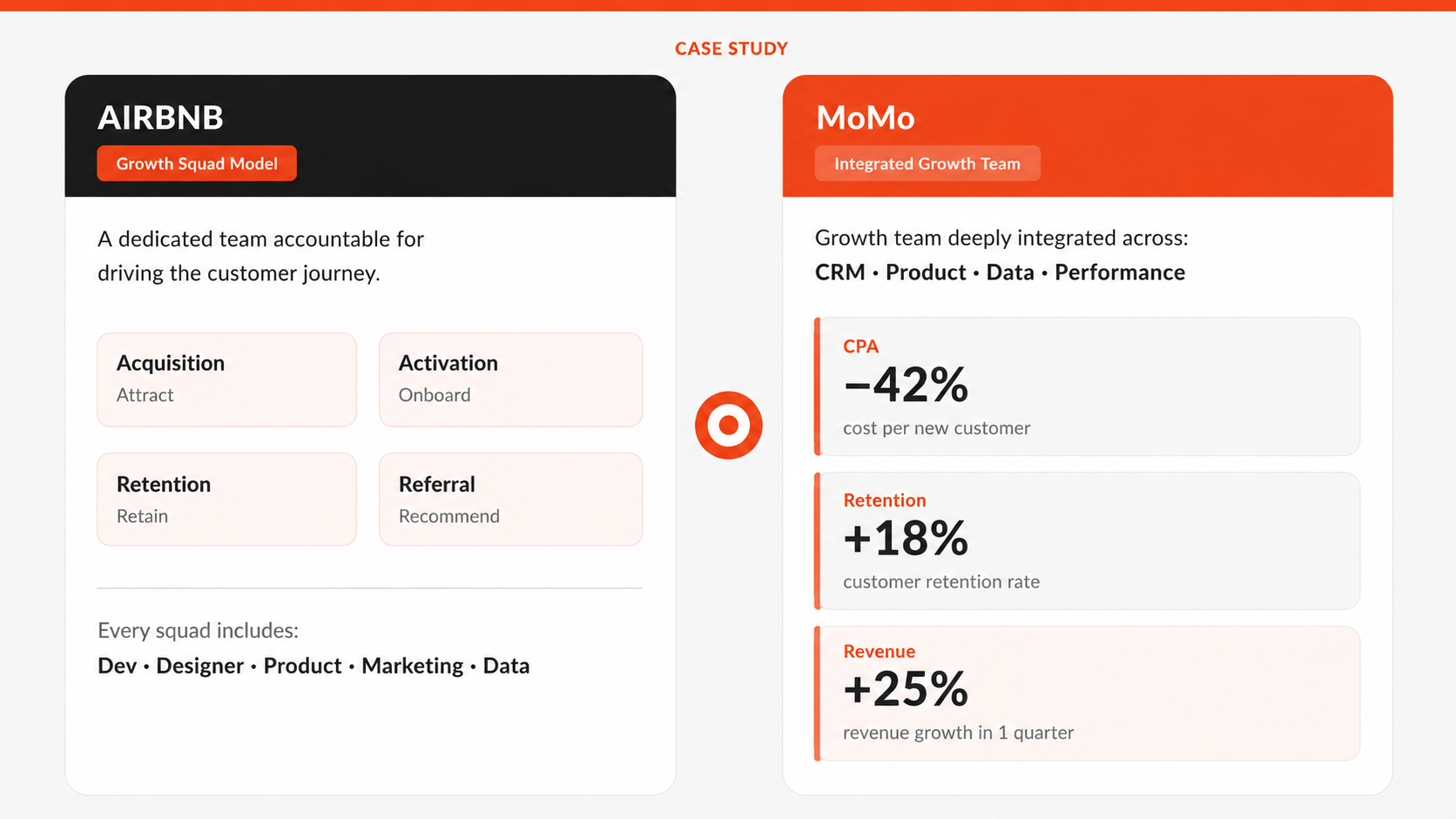
Airbnb is widely known for its squad-based growth structure.
Instead of creating one large growth department, Airbnb organizes growth around specific customer journey stages.
For example:
Acquisition Squad – Optimizes channels, targeting, and messaging.
Activation Squad – Improves onboarding and first-user experiences.
Retention Squad – Encourages repeat usage and network effects.
Referral Squad – Designs and optimizes referral programs.
Each squad includes developers, designers, product managers, marketers, and data specialists.
These squads operate like mini-startups within a larger organization.
The structure enables fast experimentation, rapid learning, and strong accountability.
4.2 MoMo's Cross-Functional Growth Approach
Vietnam's leading digital wallet, MoMo, provides another strong example.
At MoMo, growth is not owned solely by the marketing team.
Growth initiatives involve collaboration between:
Product Teams
CRM Teams
Data Teams
Performance Marketing Teams
Operations Teams
Whenever a new feature or campaign is launched, the project often includes:
Customer insight specialists
Product experience designers
Onboarding optimization teams
A/B testing specialists
Analysts monitoring bounce rates, drop-offs, CTRs, and cohort performance
This collaborative structure allows MoMo to launch new features quickly, improve user adoption rates, reduce acquisition costs, and increase user retention.
 5. Key Principles for building an effective Growth Team
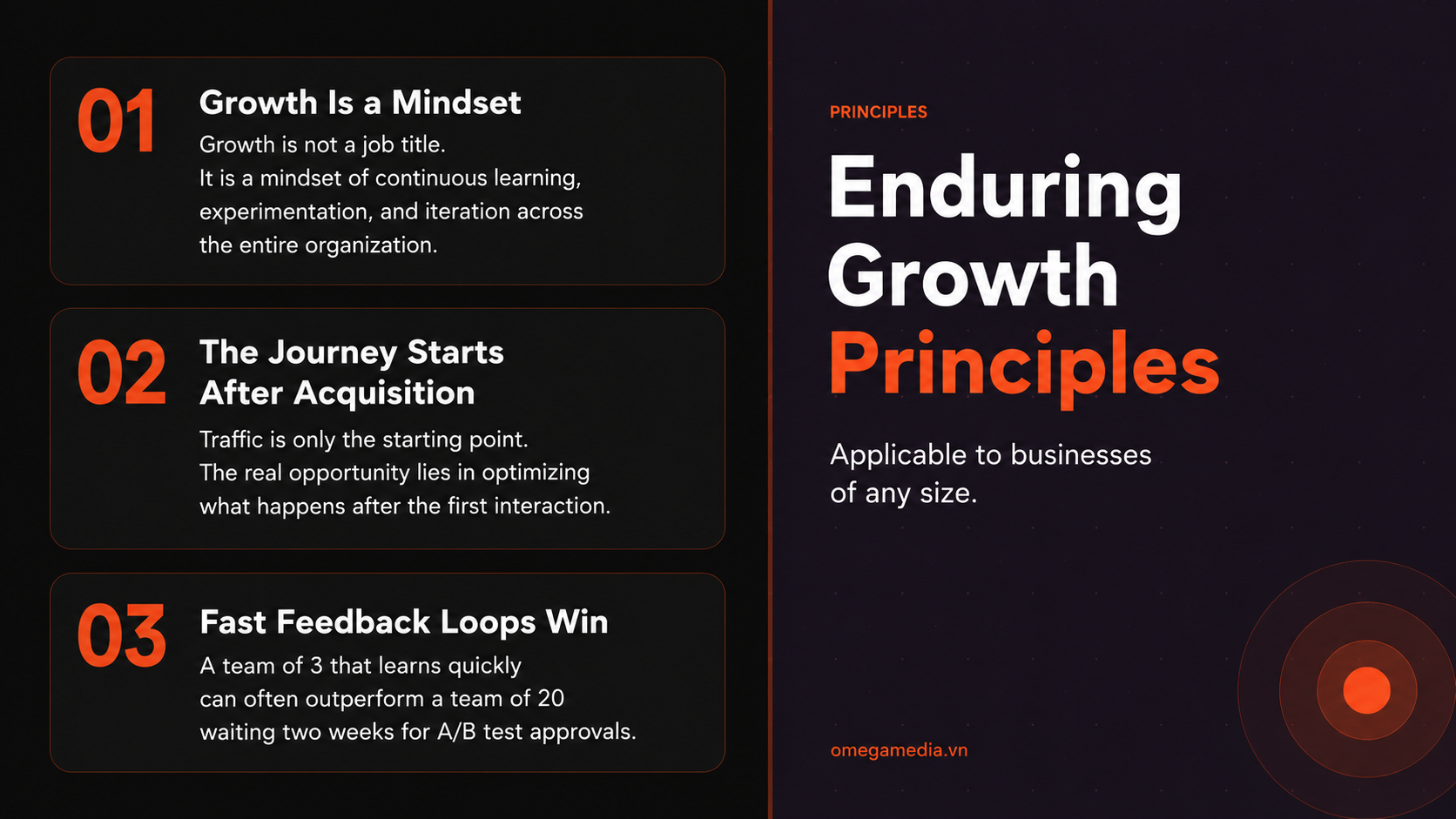
5.1 Growth is a mindset, not a job title
A company does not need a "Growth Manager" to build a growth culture.
What matters is that every team adopts a mindset of learning, testing, measuring, and improving.
Growth happens when experimentation becomes part of daily operations.
5.2 Real growth begins after customer acquisition
Many businesses focus heavily on driving traffic.
Far fewer invest the same energy into what happens after customers arrive.
If customer journeys, onboarding experiences, and retention systems are not optimized, marketing budgets are often wasted.
The most important growth question is not:
"How do we get more visitors?"
It is:
"What happens after they arrive?"
5.3 Prioritize fast feedback loops over team size
A three-person Growth Team that deeply understands customer behavior and runs experiments weekly can outperform a twenty-person team trapped in lengthy approval processes.
Growth is not about organizational size.
It is about speed of learning.
The faster a team can test, learn, and iterate, the faster it can grow.
 Conclusion
Growth is no longer a marketing problem. You do not need a large Growth Department to get started. You simply need to begin with the right question: "Where are customers dropping off, and who can help improve that experience?". When every department puts the customer at the center, shares data openly, collaborates across functions, and takes collective responsibility for outcomes, growth stops being a matter of luck. It becomes the natural result of a well-designed system.
At Omega Media, we help businesses build growth systems that align marketing, product, data, and customer experience around one shared objective: sustainable growth.
.png)